
Following Jesus’s Example | Learning How to Pray
When the struggles of life become real, do you know what to do?
When fear rises…
When temptation comes…
When you’re overwhelmed…
When you don’t know what God is doing…
When you feel like you’re in the middle of a spiritual battle…
Jesus didn’t leave us wondering how to respond.
Throughout the Gospels, we see Him living in constant dependence upon the Father. Again and again, Jesus withdrew to pray, sought the Father’s will, trusted God’s Word, and remained faithful in every circumstance. If we want to know how to navigate the spiritual battles of our own lives, there is no better example than Jesus Himself.
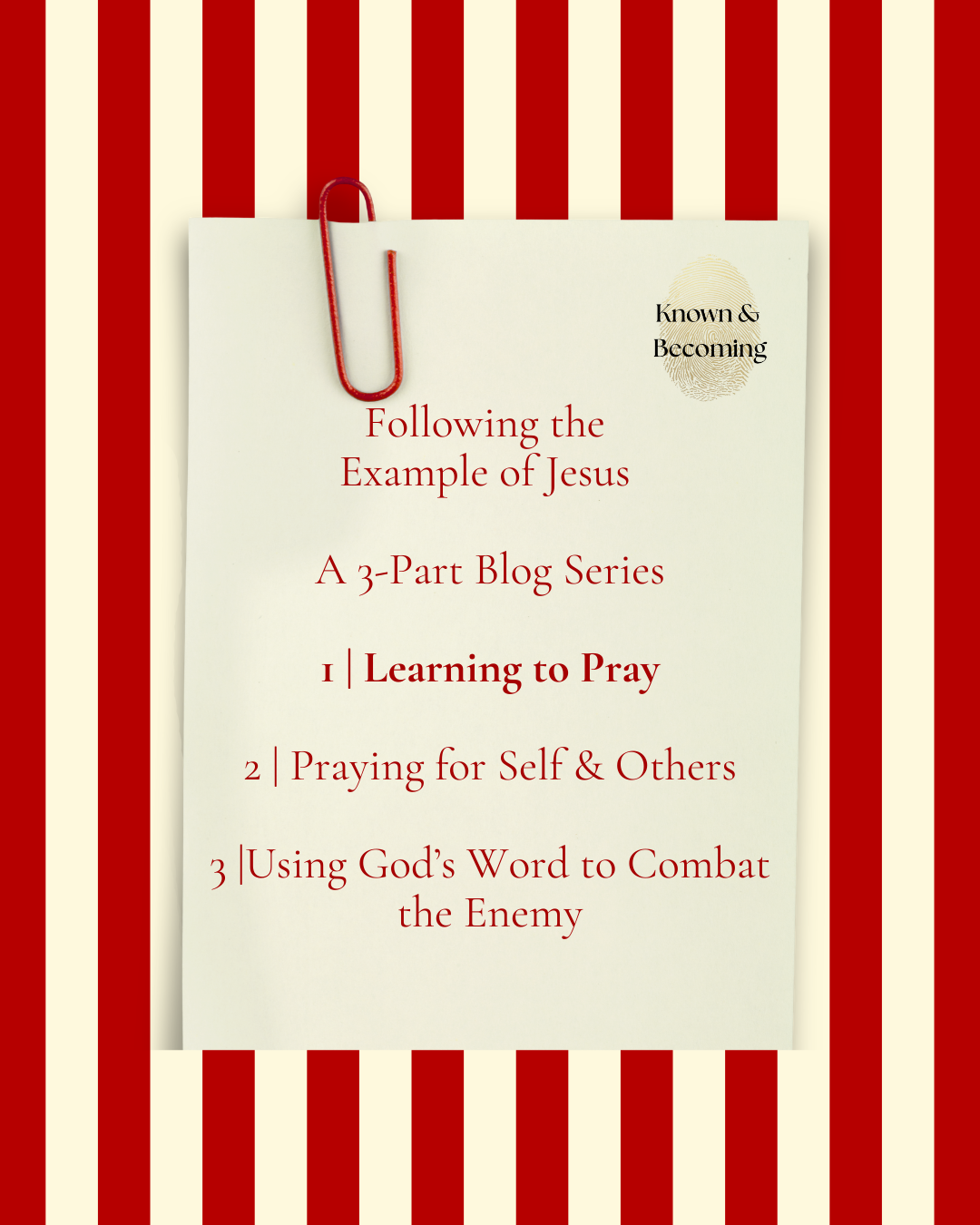
Over the next three weeks in my blog posts, I want to explore three examples Jesus gives us for living faithfully in the midst of life’s battles.
This week, we’ll begin by looking at how Jesus taught His disciples to pray through what we know as The Lord’s Prayer in Matthew 6 and Luke 11.
Next week, we’ll turn to John 17, where Jesus prays for Himself, His disciples, and all future believers. Often called His High Priestly Prayer, it gives us a remarkable glimpse into the very heart of Christ and teaches us what He considered most important to pray for.
Then, in our final Blog for this series, we’ll walk with Jesus into the wilderness as He faces Satan’s temptations. We’ll discover how Jesus responded—not with His own opinions or emotions, but with the truth of God’s Word—and what His example teaches us about standing firm against the enemy today.
How to Pray | Learning from Jesus
Jesus is portrayed as a man of prayer in all four Gospels. Prayer wasn’t simply something He did—it was woven into every part of His life and ministry. Before major decisions, after long days of ministry, during seasons of grief, and even before the cross, Jesus sought His Father in prayer.
Jesus also gave His disciples a pattern for prayer in Matthew 6:5–15 and Luke 11:2–4. Together, these passages contain what we know as The Lord’s Prayer.
Although it has long been known by that name, many Bible scholars point out that it could just as accurately be called The Disciples’ Prayer. After all, Jesus wasn’t praying this prayer for Himself—He was teaching His disciples how to pray. In fact, Jesus would never have needed to pray, “Forgive us our debts,” because He alone was without sin (Hebrews 4:15).
Rather than merely giving us words to recite, Jesus was providing a pattern that would shape the hearts of His followers. This prayer teaches us how to approach our heavenly Father, what to value most, and how to align our hearts with His will.
But before Jesus taught His disciples what to pray, He first taught them how to pray.
In Matthew 6:5–8, Jesus addresses two common temptations that can quietly work their way into our prayer lives.
The first is praying to be seen by others.
“Whenever you pray, you must not be like the hypocrites, because they love to pray standing in the synagogues and on the street corners to be seen by people.” (Matthew 6:5, CSB)
The issue wasn’t that these people prayed in public. Jesus Himself prayed publicly at times. The issue was their motivation-the posture of their heart. Their prayers had become performances rather than conversations with God. Their desire for the approval of people had replaced their desire for the presence of God.
Jesus reminds us that prayer is never about impressing others. It is about drawing near to our Father.
Then He says something that would have sounded astonishing to His listeners:
“But when you pray, go into your private room, shut your door, and pray to your Father who is in secret. And your Father who sees in secret will reward you.” (Matthew 6:6)
Notice how personal Jesus makes prayer.
He doesn’t simply say, “Pray to God.”
He says, “Pray to your Father.”
Jesus then gives us a powerful directive: go into your private room, shut your door, and pray to your Father who is in secret. And your Father who sees in secret will reward you.
So much spiritual warfare is fought behind the closed doors of our prayer closet.
It is the secret time that no one else sees- when we spend time with God in prayer and in His Word-that prepares and equips us for the battles in the spiritual realm.
When we memorize scripture, it is going into an arsenal the Holy Spirit will later bring to our remembrance when we need to access God’s truth about a situation in our lives. (John 14:26)
There is a really interesting picture of what our prayers are doing in the Throne Room of Heaven in the book of Revelation.
Revelation 8:3–4 (CSB)
“Another angel, with a golden incense burner, came and stood at the altar. He was given a large amount of incense to offer with the prayers of all the saints on the golden altar before the throne. The smoke of the incense, with the prayers of the saints, went up in the presence of God from the angel’s hand.”
Every sincere prayer offered in faith is never lost or ignored. Scripture paints the beautiful picture that our prayers rise before the throne of God like fragrant incense. He hears them, receives them, and treasures them. Even when we don’t immediately see His answer, our prayers have already reached His presence.
Jesus consistently invited His followers into a deeply personal relationship with God as their Father. Prayer is not approaching a distant ruler who must be convinced to listen. It is approaching a loving Father who already knows, already cares, and delights in hearing from His children.
Jesus then addresses a second temptation.
“When you pray, don’t babble like the Gentiles, since they imagine they’ll be heard for their many words.” (Matthew 6:7)
Jesus isn’t condemning repeated prayers. After all, He prayed the same prayer three times in the Garden of Gethsemane (Matthew 26:44), and He encouraged persistence in prayer (Luke 18:1–8).
Instead, He is warning against the idea that more words somehow persuade God to act. Pagan religions often believed their gods had to be convinced through lengthy prayers, repeated phrases, or ritual formulas.
Jesus says our Father is different.
“Don’t be like them, because your Father knows the things you need before you ask Him.” (Matthew 6:8)
That naturally raises an important question.
If God already knows what we need, why do we need to pray?
Because prayer isn’t primarily about informing God.
Prayer is about trusting God.
Prayer changes us before it changes our circumstances.
Prayer aligns our hearts with His.
Prayer deepens our dependence upon Him.
Prayer forms trust, humility, surrender, and intimacy with our heavenly Father.
God invites us into prayer not because He needs information, but because He desires a relationship with His children.
Only after laying this foundation does Jesus give us the pattern we know as The Lord’s Prayer.
“Our Father in Heaven”
Jesus begins with relationship.
Not “My Father.”
Not “The Father.”
Our Father.
Immediately, Jesus reminds us that prayer is deeply personal, but it is never isolated. Through Christ, we have been adopted into God’s family (Romans 8:15–17). Every believer approaches the same loving Father.
Yet Jesus also reminds us that our Father is in heaven.
He is near, yet He is sovereign.
He is personal, yet He is holy.
He welcomes us with open arms while reigning over all creation.
Healthy prayer holds both truths together. We approach God with confidence because He is our Father, and with reverence because He is the King of kings.
“Hallowed Be Your Name”
The first request Jesus teaches us to pray isn’t about ourselves.
It’s about God.
The word hallowed means to regard as holy, sacred, and set apart.
God’s name represents His character, His nature, His authority, and His reputation.
When we pray, “Hallowed be Your name,” we are declaring that God alone deserves worship, honor, and glory. We are also asking Him to shape our hearts so that our lives reflect His holiness.
Prayer begins with worship before it moves to requests.
That order matters.
When our eyes are lifted to God’s greatness, our problems begin to find their proper perspective.
The God we are bringing our requests to is infinitely greater than the circumstances we are bringing before Him.
“Your Kingdom Come. Your Will Be Done, on Earth as It Is in Heaven.”
After beginning with worship, Jesus immediately turns our attention to surrender.
By human nature, we want our kingdom to come.
Our plans.
Our timeline.
Our comfort.
Our success.
Our control.
But Jesus teaches us that prayer begins by aligning our hearts with God’s purposes before asking Him to bless our own.
When we pray, “Your kingdom come,” we are asking that God’s reign would be seen more fully—in our hearts, our homes, our churches, our communities, and throughout the world.
Then Jesus adds,
“Your will be done, on earth as it is in heaven.”
This isn’t passive resignation.
It is active trust.
It is saying, “Father, I may not understand what You’re doing, but I trust that Your wisdom is greater than mine. Help me want what You want.”
Jesus modeled this perfectly in the Garden of Gethsemane.
“Father, if You are willing, take this cup away from Me—nevertheless, not My will, but Yours, be done.” (Luke 22:42)
Jesus honestly expressed His desire, yet willingly surrendered to the Father’s will.
That gives us permission to do the same.
Prayer isn’t about convincing God to accomplish our will.
It’s about allowing Him to shape our hearts until we desire His will above our own.
“Give Us Today Our Daily Bread”
Jesus now teaches us to bring our needs before the Father.
Notice the simplicity of the request.
Not bread for the next ten years.
Not enough to guarantee complete independence.
Simply today’s bread.
Jesus is teaching us daily dependence.
His listeners would have remembered God’s provision of manna in the wilderness. Every morning, God faithfully provided exactly what His people needed for that day. They had to trust Him again the next morning.
The same invitation remains for us.
God certainly cares about our future, but He calls us to trust Him one day at a time.
“Daily bread” includes far more than food.
It includes wisdom for today’s decisions.
Strength for today’s responsibilities.
Peace for today’s worries.
Grace for today’s relationships.
Provision for today’s needs.
Everything we truly need comes from the Father’s hand.
Every good gift is daily bread.
“Forgive Us Our Debts, as We Also Have Forgiven Our Debtors”
Prayer naturally leads us into confession.
The closer we draw to God’s holiness, the more aware we become of our need for His grace.
Jesus uses the word debts because sin creates a debt we could never repay ourselves.
The good news of the gospel is that Jesus paid that debt completely through His death and resurrection.
Because of Christ, we don’t confess hoping God might forgive us.
We confess because forgiveness has already been made available through Him.
Confession restores fellowship.
It keeps our hearts humble.
It reminds us that we never outgrow our need for God’s mercy.
Then Jesus immediately connects receiving forgiveness with extending forgiveness.
Those who have experienced God’s grace are called to become people who freely offer grace to others.
Forgiveness doesn’t excuse sin or erase consequences.
But it does release bitterness and entrust justice to God.
“Lead Us Not into Temptation, but Deliver Us from the Evil One”
Jesus concludes by reminding us that we live in the middle of a spiritual battle.
We have a real enemy who seeks to deceive, discourage, devour and destroy.
Jesus isn’t suggesting that God tempts us. Scripture is clear that God never tempts anyone to sin (James 1:13).
Rather, this is a humble prayer of dependence.
“Father, keep me close to You. Help me recognize temptation before it takes root. Give me strength to obey You. Protect me from the schemes of the enemy.”
Victory is never found in our own strength.
It is found in abiding in Christ.
A Note About the Ending: If you’re reading from the King James Version or New King James Version, you’ll notice the familiar ending, “For Yours is the kingdom and the power and the glory forever. Amen.” Many modern translations place these words in a footnote because they are not found in the earliest surviving Greek manuscripts of Matthew. Most scholars believe this beautiful doxology was an early expression of worship used by the church and later copied into many manuscripts.
Whether it was part of Matthew’s original text or an ancient liturgical addition, it echoes biblical themes found throughout Scripture—especially David’s praise in 1 Chronicles 29:11—and serves as a fitting conclusion of worship and trust.
“For Yours Is the Kingdom…”
Jesus has just taught us to pray,
“Your kingdom come.”
The doxology reminds us whose kingdom it actually is.
It isn’t ours.
We don’t build God’s kingdom through our own strength or wisdom.
We are invited to participate in His kingdom.
Everything begins and ends with God’s sovereign rule.
Throughout Scripture, God’s kingdom represents His reign, authority, and rightful rule over all creation.
When we finish our prayers by declaring, “Yours is the kingdom,” we are reminding ourselves that God is still on the throne, regardless of what our circumstances look like.
It is a declaration of surrender.
“Father, this is Your kingdom, not mine.”
“…and the Power…”
This phrase reminds us that God not only possesses authority—He also possesses the power to accomplish His will.
How often do we pray as though the outcome depends primarily on us?
Jesus teaches the opposite.
God alone has unlimited power.
He created the universe.
He raised Christ from the dead.
He sustains every breath we take.
He accomplishes what no human effort could ever achieve.
Ending prayer with “Yours is the power” shifts our confidence away from ourselves and back onto God.
It reminds us that our prayers are not rooted in our ability but in His omnipotence.
“…and the Glory…”
Glory is the ultimate purpose of everything God does.
Throughout Scripture, God’s glory refers to the visible display of His holiness, majesty, beauty, greatness, and worth.
Prayer ultimately isn’t about making our name known.
It’s about making His name known.
We ask for healing…
…so He receives glory.
We ask for wisdom…
…so He receives glory.
We ask for provision…
…so He receives glory.
Even our salvation exists,
“to the praise of His glorious grace” (Ephesians 1:6).
Every answered prayer ultimately points back to Him.
“…Forever”
This single word stretches our perspective beyond today.
Earthly kingdoms rise and fall.
Governments change.
People come and go.
But God’s kingdom, power, and glory never diminish.
They have no expiration date.
He reigns forever.
This echoes many Old Testament passages, particularly David’s prayer:
“Yours, LORD, is the greatness and the power and the glory and the splendor and the majesty… Yours is the kingdom, LORD, and You are exalted as head over all.” (1 Chronicles 29:11)
Many scholars believe the doxology intentionally echoes David’s praise, bringing the prayer to a fitting conclusion of worship.
“Amen”
The final word is small but significant.
Amen comes from the Hebrew root אָמַן (’aman), meaning to be firm, faithful, reliable, or true.
It isn’t simply a signal that the prayer is over.
It is a declaration of faith.
It means,
“It is true.”
“So be it.”
“I trust You.”
When we say “Amen,” we are placing our confidence in the faithfulness of the God to whom we have prayed.
After teaching His disciples how to pray, Jesus modeled what a God-centered prayer life looks like in John 17.
Next week, we will discover what He prayed for Himself, His disciples, and every believer who would one day follow Him—including you and me.
Then, in our final week in this three part series, we’ll step into the wilderness and watch Jesus confront Satan’s temptations. We’ll see how He answered every lie with the truth of God’s Word and discover how His example equips us to stand firm in our own spiritual battles today.
